
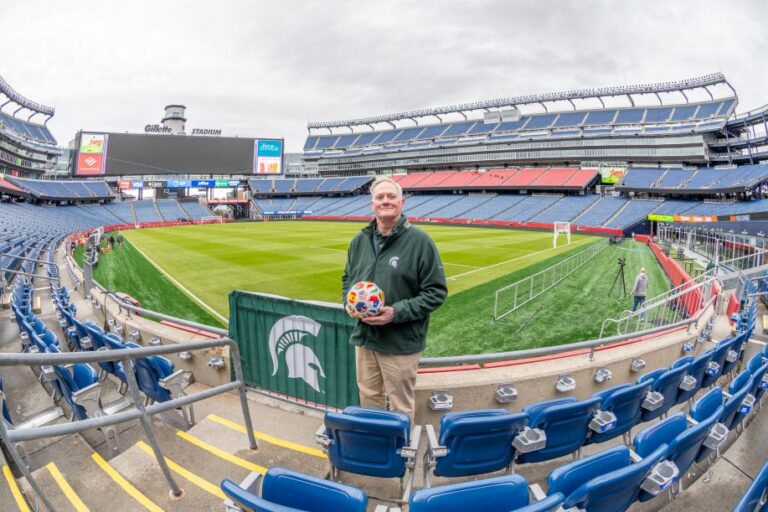
The FIFA World Cup 2026 tournament is less than a month away. One of the biggest challenges facing the turfgrass scientists at Michigan State University (MSU) and the University of Tennessee is ensuring the consistency of the natural turfgrass across three continents, 16 cities and three distinct climate zones.
While Vancouver, Canada; Kansas City, Missouri; and Mexico City, Mexico are completely different cities, during the World Cup, the turfgrass in their stadiums must be consistent and feel the same to the world’s elite athletes — whether they are playing the first game of the tournament or the final match more than five weeks later.
John “Trey” Rogers III, professor of turfgrass research in the College of Agriculture and Natural Resources, leads a team of researchers at MSU in collaboration with a team at the University of Tennessee, led by Spartan alum John Sorochan. MSU shared an interview with Rogers about how MSU has played a role in making sure the turfgrass is ready for gameplay. The following is an excerpt from that interview:
How are you ensuring the consistency of the turfgrass for the World Cup?
To make sure 16 different stadiums in three different climates play the same, we had to control everything from the exact mix of grasses, how the surface is built and reinforced, and the turf and soil specifications so the field is ready to perform and recover after every match.
What are the types and mixture of turfgrass used in the stadiums?
We developed the recipe for each of the sod farmers who grew the natural turfgrass used for the World Cup. Some stadiums are using a mixture of 84% Kentucky bluegrass and 16% perennial ryegrass. Other cities are using 100% bermudagrass, depending on the climate zone of the stadium.
How was the turfgrass grown at the sod farms?
The sod farmers used the seed mixtures we provided, and they grew the turfgrass on what’s called sod-on-plastic. This idea isn’t new, but when we used sod-on-plastic for the FIFA World Cup 1994 in the Pontiac Silverdome, it was a game changer.
Normally, when sod is harvested, it is cut from its roots, shocking the grass. This means that when the sod is installed, it needs time and lots of water to reestablish its root system. But when you grow sod-on-plastic, the entire root system is preserved. When the sod is harvested, it is rolled up like a carpet including the roots. At the stadium, the sod is unrolled and, once it is installed, it is almost ready for gameplay that same day.
The gameday readiness of the sod from the farm to the stadium keeps getting better. The way the sod is prepared at the farm eliminates the prep in the stadium, helping us with the one element that is not our friend in multiuse stadiums — time. This is one of the keys to our success.
How is sod-on-plastic transported from the sod farm to the stadiums?
Big rolls of sod measuring 30 to 40 feet long and 42 inches (or about 3 1/2 feet) are loaded into refrigerated trucks that hold an average of 10 to 15 rolls and driven to the stadiums. Some of the farms are close to the stadiums they are being installed in, but some aren’t. One of the longest trips is from a sod farm in Colorado, which will transport the turfgrass all the way to a stadium in Atlanta.
How is the turfgrass strengthened or reinforced to withstand vigorous gameplay?
There are two ways the turfgrass is reinforced. One way happens at the sod farm, where a plastic fiber carpet is laid down as the turfgrass is grown. The other is a method for reinforcing the turfgrass after it’s installed at the stadium. Green plastic fibers are stitched or woven into the turfgrass using a machine with needles spaced 1 inch apart to strengthen the turfgrass surface for gameplay.
How did you test turfgrass for gameplay?
We use machines like the foot lower extremity, or fLEX, machine, developed at UT, which simulates a 170-pound player during gameplay. The machine has a soccer cleat that strikes the turfgrass surface, and the information is displayed on a screen and available for analysis later so that we can test the wear-and-tear on the turfgrass.
We also use a ball drop machine that drops a soccer ball from 6 feet in the air, and we measure the audio of the ball hitting the ground and bouncing to learn more about how the ball is interacting with the turfgrass surface.
How do you keep natural turfgrass alive throughout the tournament?
There is a multilayered system under the turfgrass per FIFA’s standards. All the stadiums must have an automatic irrigation system and grow lights to keep the turfgrass green for eight weeks.
In the fields that have permanent turfgrass, the first layer is sod followed by the reinforcement layer. The next layer is the turfgrass root system. This has 12 inches of sand to meet FIFA’s specifications. The third layer is for drainage and includes 6 inches of gravel. Finally, there is a vacuum and ventilation layer that ensures the turfgrass gets air and any excess water is removed.
For the fields that will only have temporary turfgrass, the main differences are in the rootzone layer, which is 6 to 10 inches of sand to meet FIFA’s specifications, and the drainage layer has 4 to 6 inches of gravel or a plastic drainage module called Permavoid, which is a temporary irrigation system.
How did you anticipate the athletes’ expectations from the turfgrass and its performance?
These are the best soccer athletes in the world, so they understand if the turfgrass is too high or too low or if the field is a little soft. We have met FIFA’s specifications and will support the 16 stadiums throughout the games so that the last thing the players worry about is the field.