
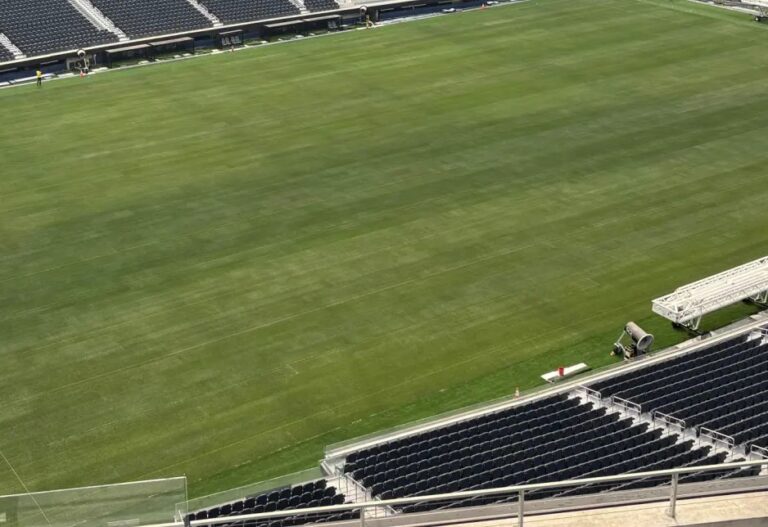
When the world’s best soccer players arrived in North America for the 2026 FIFA World Cup, they stepped onto playing surfaces supported by years of research, construction, testing and daily field management.
Behind those surfaces were sports field management professionals working at match stadiums, national team base camps, training grounds, sod farms and research facilities throughout the United States, Canada and Mexico. Several of those professionals have also served SFMA as board officers, presidents and longtime industry leaders.
Their contributions demonstrate the range of expertise required to deliver the world’s largest soccer tournament. Some helped develop the systems used across all 16 stadiums. Others converted venues that were never designed to support natural grass. Still others managed the fields where national teams prepared each day between matches.
Together, their work placed the sports field management profession in front of a global audience.
Abby McNeal helps lead FIFA’s tournament-wide pitch operation
SFMA Past President Abby McNeal, CSFM, CPRP, brought decades of field management and major-event experience to the tournament as a manager for the 2026 FIFA World Cup.
McNeal’s role extended beyond a single stadium or field. She worked as part of FIFA’s broader pitch management operation, helping coordinate the people, planning and standards required to deliver fields across three countries.
The unprecedented scale of the tournament presented a major operational challenge. The 2026 World Cup included 104 matches in 16 stadiums, along with dozens of team base camps and training sites. Each surface had to meet FIFA’s expectations for safety, consistency, ball response and visual presentation, regardless of differences in climate, construction or venue design.
McNeal also contributed to the delivery of training pitches in Vancouver, working alongside local field professionals and tournament partners. Those training surfaces were essential to team preparation and required the same close attention to performance, testing and maintenance as the stadium fields.
Her role reflects the value of SFMA professionals who understand both the technical requirements of a playing surface and the coordination needed to manage people, schedules, contractors and expectations during a global event.
McNeal’s assignment is especially meaningful for SFMA. As a past president and longtime advocate for the profession, she has helped strengthen the visibility and credibility of sports field managers throughout her career. Her work with FIFA placed that leadership experience at the center of one of the most complex field-management operations ever assembled.
Learn more about Abby McNeal’s World Cup role and career.
Jason DeMink brings big-event experience to Hard Rock Stadium
Current SFMA Secretary/Treasurer Jason DeMink, CSFM, temporarily traded the University of Michigan’s athletic facilities for one of the World Cup’s busiest environments.
DeMink joined the tournament’s pitch team at Hard Rock Stadium in Miami, arriving in Florida in May to help prepare and maintain the natural-grass playing surface.
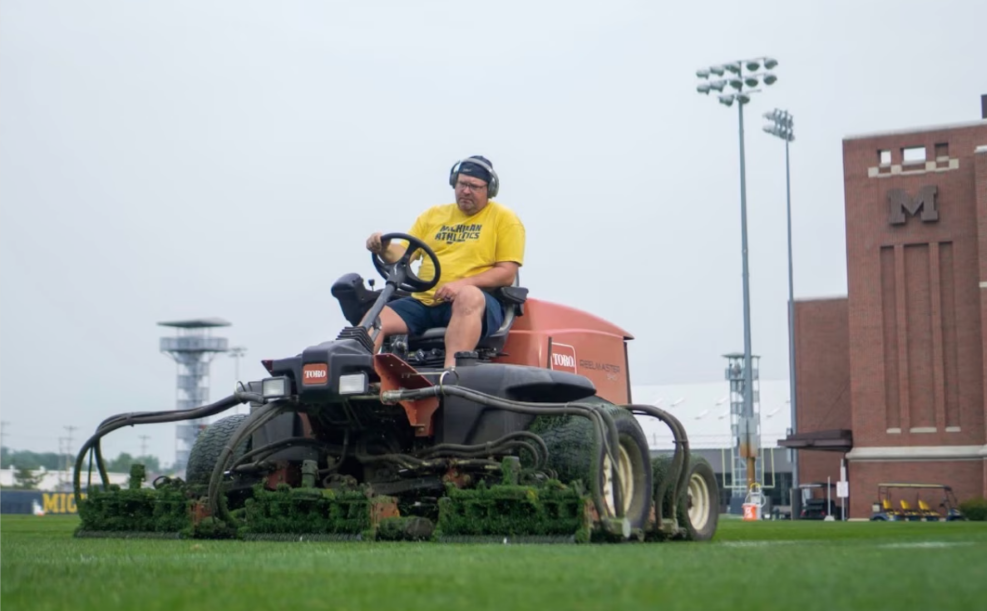
Hard Rock Stadium presented the type of assignment that requires adaptability, precision and constant communication. Although the venue regularly hosts NFL football and other major events, a World Cup soccer pitch has its own dimensions, performance benchmarks and maintenance requirements.
DeMink brought experience from championship-level events, including work connected to professional baseball and college athletics. At Michigan, he is accustomed to managing high-profile fields under intense schedules and public scrutiny. The World Cup, however, introduced additional demands: FIFA testing, international teams, changing weather, tightly controlled maintenance windows and the expectation that each match surface perform consistently.
His work in Miami included preparing a natural-grass pitch inside a multipurpose stadium and collaborating with an international team of grounds professionals.
That collaboration is one of the defining characteristics of major tournaments. While television coverage focuses on players and matches, the surfaces are often delivered by temporary teams made up of venue staff, FIFA specialists, contractors, researchers and experienced field managers recruited from other organizations.
DeMink’s participation also reflects an important part of SFMA leadership: members do not simply represent the profession through board service. They continue practicing it at the highest levels and bring the knowledge gained from major assignments back to their colleagues, students and local facilities.
Read more about Jason DeMink’s work at Hard Rock Stadium.
James Bergdoll prepares Spain’s base camp in Chattanooga
While stadium crews prepared fields for matches, SFMA Past President James Bergdoll, CSFM, was responsible for another critical piece of tournament infrastructure: the daily training environment for Spain’s national team.
Spain selected the Baylor School in Chattanooga, Tennessee, as its World Cup base camp. As Baylor’s director of grounds, Bergdoll was responsible for preparing and maintaining the school’s natural-grass soccer facilities for one of the tournament’s most closely watched teams.
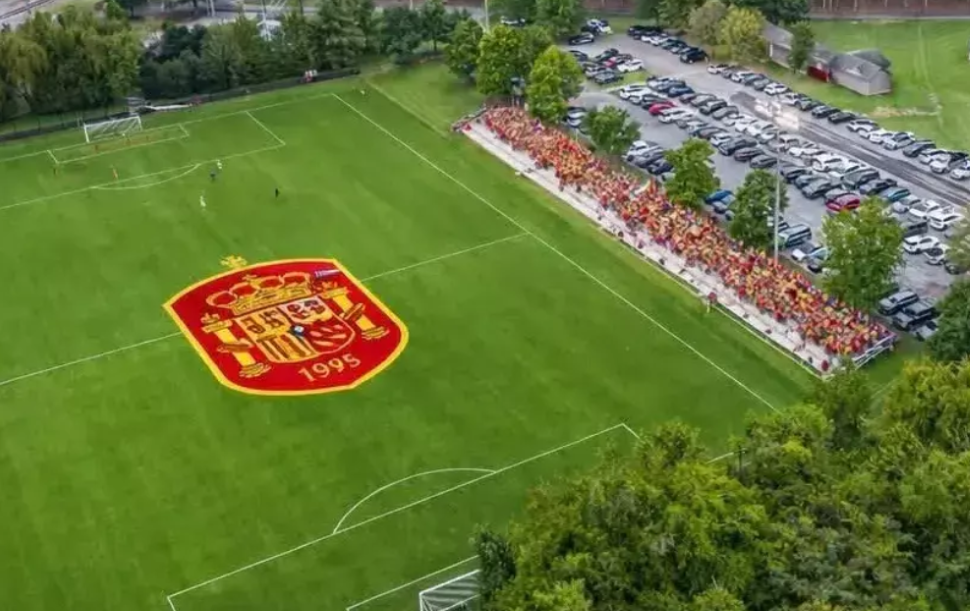
The assignment required months of advance preparation. FIFA evaluated the surface for factors including ball roll, ball bounce, firmness, traction and the way the field responded when a player planted and changed direction.
To refine the pitch, Bergdoll and his team used management practices including sand topdressing, verticutting and aerification. Every treatment had to support both agronomic health and elite-level playability.
Once Spain arrived, Bergdoll worked with team representatives daily to make sure the field met their needs. The team trained on Baylor’s primary varsity field and an adjoining partial field, using the complex for passing drills, small-sided sessions, tactical preparation and full-team work.
Managing a national team’s base camp also meant responding to rapidly changing conditions. Weather, practice schedules, player recovery sessions and team requests could all affect the maintenance plan. Bergdoll acknowledged that the responsibility came with nerves, particularly as changing weather conditions influenced the field in the weeks before Spain’s arrival. The result was a surface used daily by some of the world’s most recognizable players, and the eventual 2026 World Cup Champions.
Bergdoll described the experience as a career honor and an opportunity to represent the turfgrass industry on an international stage. His work reinforced the importance of training grounds, which may not receive the same attention as stadium fields but directly influence how teams prepare, recover and perform.
Read about Spain’s training experience at Baylor School.
See how the Baylor pitch was prepared and tested.
Murray Cook and BrightView transform SoFi Stadium
SFMA Past President Murray Cook and the BrightView Sports Turf team helped solve one of the tournament’s most complicated venue-conversion challenges at SoFi Stadium in Los Angeles.
SoFi Stadium was built with a synthetic playing surface over a concrete slab. It did not include the traditional subsurface drainage infrastructure found beneath a permanent natural-grass field. To host World Cup matches, the venue needed a larger, natural-grass soccer pitch capable of meeting FIFA’s standards.
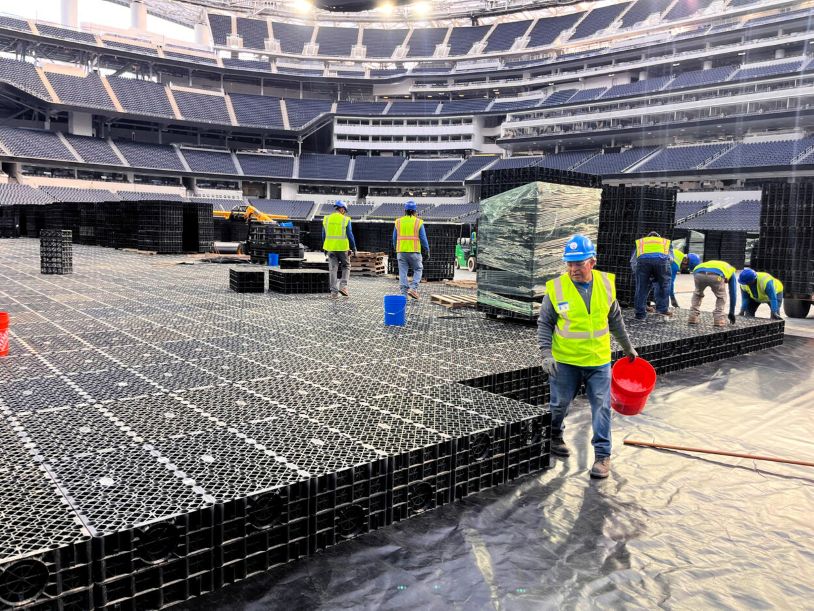
BrightView and its project partners constructed a temporary field system that included a sealed liner and carefully engineered water-management components. The design functioned like a contained basin, allowing irrigation and drainage to be controlled without permitting water to reach areas below the playing surface.
The team also had to contend with SoFi Stadium’s roof and limited natural light. Managing living grass inside a covered multipurpose venue requires careful use of supplemental lighting, moisture management and environmental monitoring.
At the height of the project, more than 50 BrightView team members were working inside the stadium. The installation represented far more than laying sod. Every layer beneath the grass influenced drainage, stability, rooting, firmness and performance.
Cook, president of BrightView Sports Turf, emphasized that the unusual environment left little room for error. The pitch had to be built inside a stadium that was not originally designed for natural grass, under international scrutiny and within a fixed tournament schedule.
BrightView had previously converted the stadium for the 2025 Concacaf Nations League., providing valuable experience before the larger 2026 assignment. The World Cup build expanded on that work and required a wider pitch, additional engineering and even closer coordination among construction, stadium and field-management teams.
Cook’s involvement connects the modern World Cup to decades of SFMA leadership. His career has included sports field projects in more than 30 countries, and he previously served as president of the SFMA.
Explore the SoFi Stadium pitch-construction project.
John Sorochan and the research behind every stadium pitch
The influence of SFMA members and educators extended across every World Cup stadium through the FIFA Pitch Research Project.
Dr. John Sorochan, distinguished professor of turfgrass science at the University of Tennessee, worked with researchers from the University of Tennessee and Michigan State University to study how natural-grass surfaces could be delivered consistently across dramatically different venues.
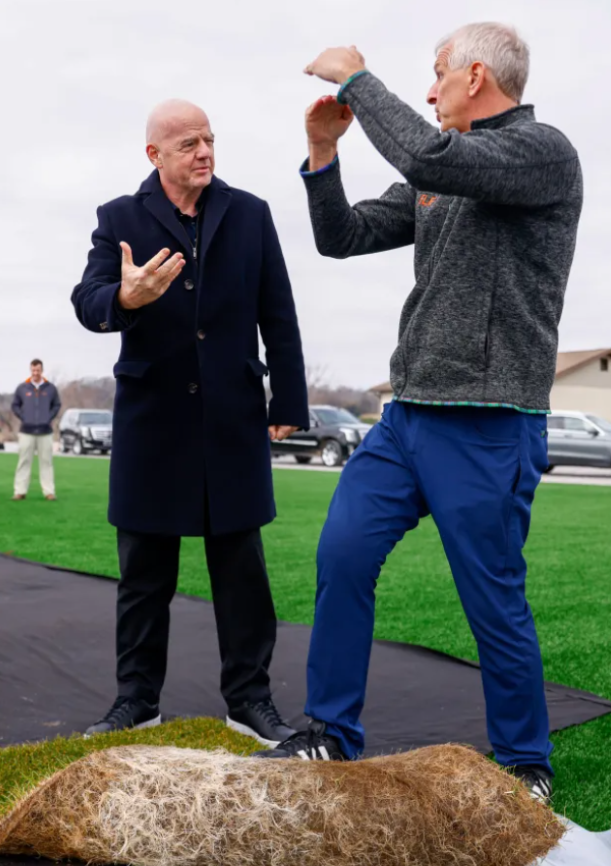
The challenge was unprecedented. Fields were needed in warm, humid climates; cool northern locations; high elevations; open-air stadiums; retractable-roof facilities; and fully enclosed venues. Several host stadiums normally used synthetic turf and had to be temporarily converted to natural grass.
The research team studied grass varieties, hybrid reinforcement systems, sod production, supplemental lighting, irrigation, drainage, installation techniques and surface-testing equipment.
Researchers also evaluated how the field interacted with both the athlete and the ball. Specialized machines simulated repeated cleat traffic and measured how force moved through the playing surface. Ball-roll and ball-bounce testing helped determine whether the pitch would support predictable, consistent play.
The project produced different grass strategies for different regions. Warm-season bermudagrass systems were suited to some southern venues, while mixtures involving Kentucky bluegrass and perennial ryegrass were used in cooler environments and certain indoor stadiums.
Much of the tournament sod was grown through specialized production systems designed to preserve the roots during harvest. Some fields traveled more than 1,000 miles in refrigerated trucks before installation. Once installed, the grass needed time to establish before matches began.
Sorochan’s connection to the World Cup dates back to 1994, when he helped install and maintain the natural-grass field inside the Pontiac Silverdome as a Michigan State University student. That experience helped inspire questions about how indoor natural-grass systems could be improved.
More than three decades later, his research helped shape the systems used throughout the 2026 tournament.
Watch CBS Sunday Morning’s feature on the FIFA Pitch Research Project.
Listen to the USGA’s conversation with Dr. John Sorochan.
Learn more about the science behind the World Cup pitches.
Jake Mays helps install the World Cup Pitch in Houston
For Jake Mays, CSFM, the World Cup presented an opportunity to take the knowledge he uses every day at The Westminster Schools and apply it inside one of the tournament’s match stadiums.
Mays, who serves on the SFMA Board of Directors as the K–12 Schools representative, joined the professional team responsible for installing the natural-grass World Cup pitch at NRG Stadium in Houston.
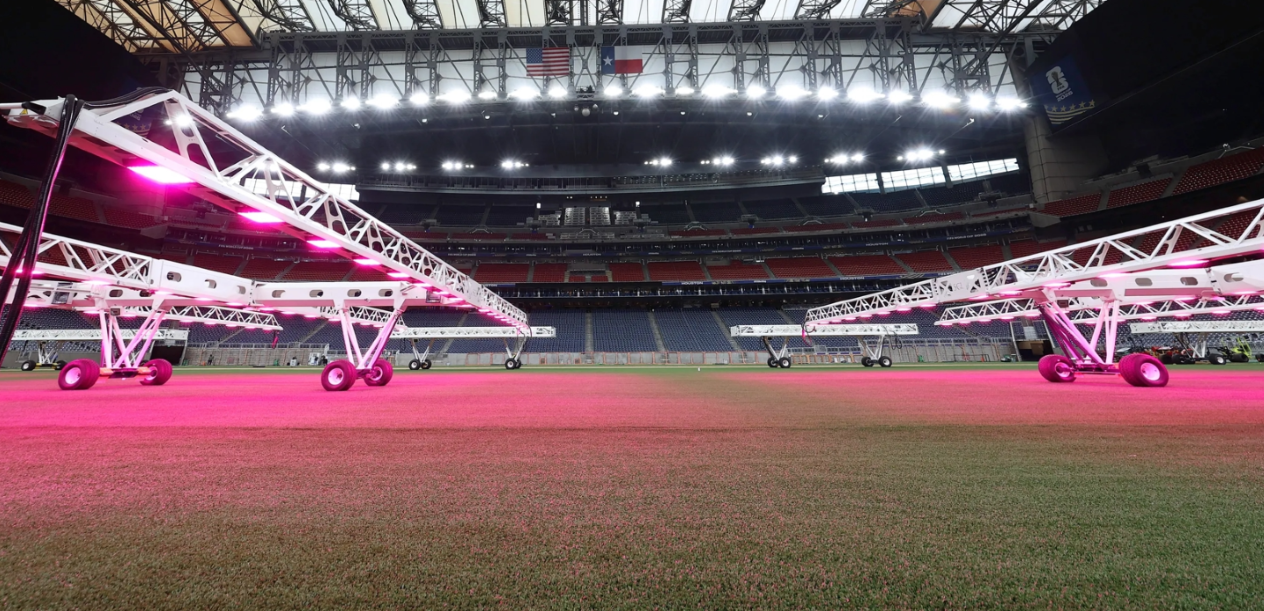
NRG Stadium normally uses an artificial playing surface. Hosting World Cup matches required the venue to be converted to a regulation-size natural-grass soccer field capable of meeting FIFA’s testing and performance requirements.
The Houston installation also carried special significance for the tournament’s pitch program. FIFA identified it as the final one of the 16 stadium pitches to be completed. The last section of grass was installed on June 4, marking the completion of the match-field construction program across all three host countries.
Mays participated in the physical installation of the Houston surface as part of an experienced, high-pressure crew. The work involved much more than placing rolls of grass over an existing stadium floor. The finished pitch depended on precise coordination among the sod producer, transportation teams, installation contractors, FIFA representatives, researchers, stadium personnel and field managers.
Each section needed to be positioned tightly and evenly so that the completed surface functioned as one continuous field. Seams, elevation changes or instability beneath the sod could affect ball movement and player footing. The crew therefore had to work methodically while also meeting a firm tournament deadline.
At Westminster, Mays oversees approximately 200 acres of campus grounds and 12 acres of athletic fields. His experience provided a strong foundation for the World Cup assignment. Successful field installation requires the same qualities demanded by school sports field management: attention to detail, adaptability, technical knowledge, teamwork and the ability to perform under a schedule that cannot easily be changed.
His participation in Houston illustrates how expertise developed at a school or community facility can translate to the highest level of international competition. The scale and audience may have been different, but the fundamental objective remained the same: provide athletes with a safe, consistent and dependable playing surface.
Listen to Jake Mays discuss his World Cup experience with Westminster WCAT.
Read FIFA’s account of the Houston pitch installation.
Learn more about Jake Mays and the SFMA Board of Directors.
More than match fields
The contributions of SFMA leaders illustrate how many different types of playing surfaces support a World Cup.
The match stadiums receive the greatest visibility, but each national team also needs a dependable base camp and training field. Additional practice sites must be available near match venues. Sod farms must produce specialized grass months in advance. Construction teams must build temporary field systems. Researchers must test performance. Local field managers must then maintain each surface through practices, matches, weather events and tournament operations.
A stadium pitch can influence player footing, ball movement and the rhythm of a match. A training field can affect preparation and recovery. Inconsistency in either environment can become a distraction or, in the worst cases, a safety concern.
The work performed by McNeal, DeMink, Bergdoll, Cook, Sorochan, Mays and many other SFMA members demonstrates that sports field management is both a highly technical profession and a deeply collaborative one.
The 2026 FIFA World Cup provided an extraordinary showcase for natural-grass management, sports field construction, research and professional collaboration. It also highlighted the leadership found throughout SFMA, from former presidents and current board officers to researchers, venue managers, contractors and local crew members.
For SFMA, their participation is a powerful reminder that the knowledge shared throughout the association is being applied at every level of sports, from community facilities and school fields to national team training grounds and the world’s largest stadiums.
The players made World Cup history on the field. Sports field management professionals made sure the field was ready.