
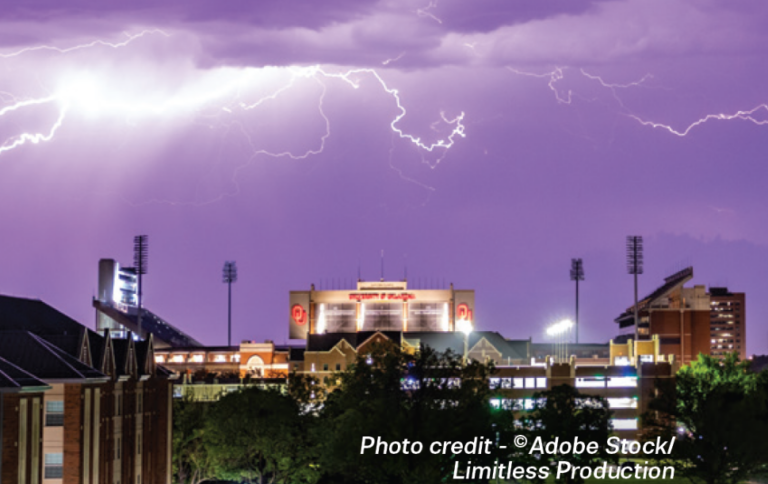
Lightning poses a significant risk to outdoor sports and special events, endangering participants, spectators and staff. Given the unpredictable nature of thunderstorms, it is essential to have a comprehensive lightning safety plan in place to protect everyone involved.
The Cybersecurity and Infrastructure Security Agency (CISA), in partnership with the National Center for Spectator Sports Safety and Security (NCS4) and the University of Southern Mississippi, recently released the Lightning Safety Guide for Sports and Special Events, which provides practical, scalable guidance for venue owners, operators, and event organizers.
According to CISA, the Lightning Safety Guide outlines critical measures and considerations to ensure safety and reduce the risks associated with lightning strikes, including tear-away pages on lightning safety considerations for small and large events. The preparation, education, and clear procedures outlined in the guide will minimize lightning-related injuries and disruptions, creating a safer environment for outdoor events.
“The mission of this guide is to enable and empower venue managers and event organizers to prioritize lightning safety at outdoor events,” CISA stated. “Through strategic collaboration with business-oriented and data-driven approaches, we aim to cultivate advocacy and address critical challenges, ensuring the well-being of all participants and attendees.”
This centralized operational planning structure approach provides reasonable mitigations across various programs and creates a credible, consistent method that unites business and safety decisions.
“Through these efforts, we aim to provide a pathway for scalable resources and incident statistics to event owners and venue operators, facilitate informed decision-making, and help create a safer and more harmonized landscape for sports and outdoor events globally,” CISA added.
The following tips are excerpted from the Lightning Safety Guide for Sports and Special Events:
Lightning detection system considerations
With modernized technology and mobile communications technology, it is no longer necessary to rely only on observation to determine where lightning is occurring. This technology allows end-users to quickly access where the closest lightning strike is located, where lightning activity is occurring, how it is evolving, and the chances of it occurring at a specific location by a certain time.
There are a variety of lightning detection methods, ranging from ground-based to satellite-based lightning detection networks. Venue managers and event coordinators have sophisticated data-driven resources readily available to help better inform lightning-based decisions for outdoor events. Whether lightning data is provided by venue-specific lightning detection infrastructure or mobile software applications, there is a spectrum of options to receive critical, high-quality, and real-time lightning information and alert notifications at a range of costs.
When considering lightning detection systems, venue managers should carefully assess key features to ensure the system meets alerting, interface, coverage, and integration needs. Venue managers should also consider the need for real-time augmentation with support from a professional meteorologist or weather specialist.
Lightning-safe structures
Although the best defense is to avoid lightning conditions altogether, that is not always possible. Prior to an event, venue managers should identify safe locations and understand how long it will take to get people to safety.
Venue managers should assign two key players for every event: a designated Weather Safety Official and a designated Authorized Decision-maker. The designated Weather Safety Official is responsible for monitoring weather conditions (including lightning) to provide the Decision-maker with as much lead time as possible. The designated Authorized Decision-maker is responsible for determining when and how the venue’s lightning safety plan is initiated, including delays, cancellations, and shelter-in-place or evacuation orders. Depending on event needs and staffing, these responsibilities may be done by the same person.
Lightning safety plans
Lightning safety plans are not one-size-fits-all. For example, the lightning safety plan for a recreational swimming facility will differ from a nearby sports stadium despite the likelihood of these venues being affected by the same lightning occurrence.
The lightning safety radius for a venue should be based upon multiple factors
- Size of venue
- Number and demographic of the patrons
- Speed of the inbound lightning risk
- Decision time needed for event stoppage
- Time needed for egress from the spectator areas
- Proximity of suitable available lightning shelters
- Completion time needed for evacuation
- Ingress into a lightning shelter
The varying scope and scale of outdoor events may also require information and decision support services to help guide the appropriate lightning safety response.
Venue managers may consider:
- Professional onsite or remote meteorologist
- Grounding solutions with the installation of lightning rods
- Subscription to a lightning data notification service (perhaps multiple for redundancy)
- Onsite lightning detection infrastructure system
Further, venue managers/event coordinators with fixed staffing may consider annual lightning (or general weather) safety training as a force multiplier to enhance lightning forecasts, detection, decision-making, and safety response efforts.
A lightning safety plan should outline ways to allocate various resources based on the forecast or current lightning threat level. These resources may include pre-assembly of staff, increased information dissemination, the opening of shelters, and minute-by-minute monitoring.
In addition, the unpredictable nature of lightning demands that safety plans account for the anticipation of lightning within a predetermined safety radius rather than waiting for the lightning to occur within a venue’s safety radius.
A lightning safety plan should integrate seamlessly with existing infrastructure and safety systems. This integration ensures that lightning safety measures provide continuity with other safety protocols, eliminating conflicts or disruptions.
Resuming an event
In addition to determining trigger points associated with the response to a threat of lightning, venue managers also identify when and how an event will be resumed or canceled. NOAA recommends the following criteria for resuming an event.
If the venue is consulting with a professional meteorologist who is using real-time cloud-to-cloud and cloud-to-ground lightning data, the event may resume if ALL the following conditions are met:
- Lightning has moved beyond 8 miles of the venue.
- The storm motion is taking the lightning activity away from the venue.
- The threat of new lightning strikes within 8 miles of the venue has ended.
If the venue does not consult with a professional meteorologist who is using real-time lightning data, the venue will wait 30 minutes after no thunder or lightning is observed before resuming activities.
The Lightning Safety Guide for Sports and Special Events
These are just a few brief excerpts from the Lightning Safety Guide for Sports and Special Events. The full guide is a comprehensive, 33-page resource that covers the science of lightning, environmental factors, risk assessment, protective action planning, detection and prediction, communication, event cancellation or resumption, staff training and much more. It also includes Safety Operation Plans specific to various event sizes, as well as government support and resources for lighting safety.
To access/download the full guide, please visit the Lightning Safety Guide (PDF)
For more information on lightning safety from the National Lightning Safety Council, visit lightningsafetycouncil.org.