
By Mary Helen Sprecher
A new study on pickleball published by the Sports and Fitness Industry Association identified the top complaint among players: Overcrowding on courts.
While it’s easy to write off the cause as the surging popularity of the sport, the root of the problem goes deeper. In fact, a big contributor is the fact that many clubs, resorts, parks and schools are trying to satisfy the demand for pickleball quickly by adding pickleball lines to tennis courts. And that’s just creating problems, namely a glut of people trying to find court time in the same spaces.
It’s really a perfect storm. For one, tennis is gaining players as well. The U.S. Tennis Association’s (USTA’s) Todd Carlson, senior director, Tennis Venue Services, Parks and CTAs, noted that in the last five years, tennis has grown, adding seven to eight million players. USTA wants to bump up the total number of players to 35 million by 2035, and it is actively working to do so.
And all those people are going to need places to play.
“If we want to keep adding players, we have to add tennis courts,” said Carlson. “Trying to take existing courts and add lines for multiple sports only means more people competing for the same space. The key to growth is to support tennis-specific courts.”
He added that there is a precedent. As it happens, it’s one that should be familiar to every facility manager.
“It’s similar to what happened when softball first became popular; people originally thought that baseball diamonds could host everything,” said Carlson. “They very quickly realized that too many people wanted to use the same diamonds, and that the answer was to build more diamonds so that everyone could play and both sports could grow.”
An extension to the problem of court crowding is the fact that with both sports continuously drawing players who want to use the courts, parking facilities likewise become congested, leading to additional traffic and more competition for parking spaces in nearby neighborhoods and on adjacent streets.
To try to maintain harmony among players of both sports (as well as those in local neighborhoods), the USTA has created guidance for the discussions around shared spaces; this can provide a jumping-off point for decision-making.
Option 1: Sport-specific sites
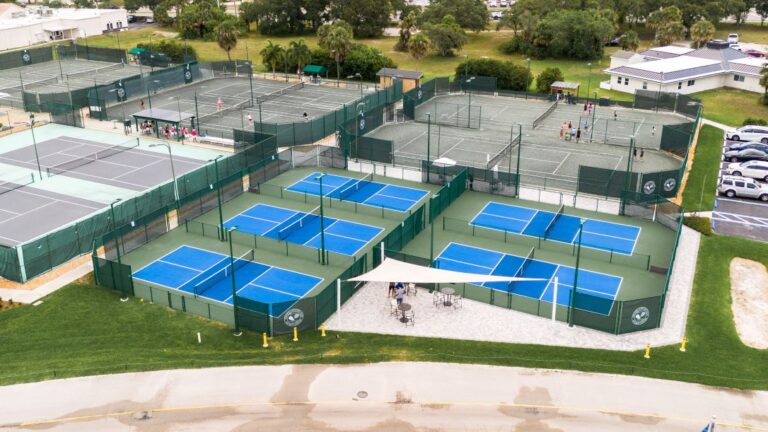
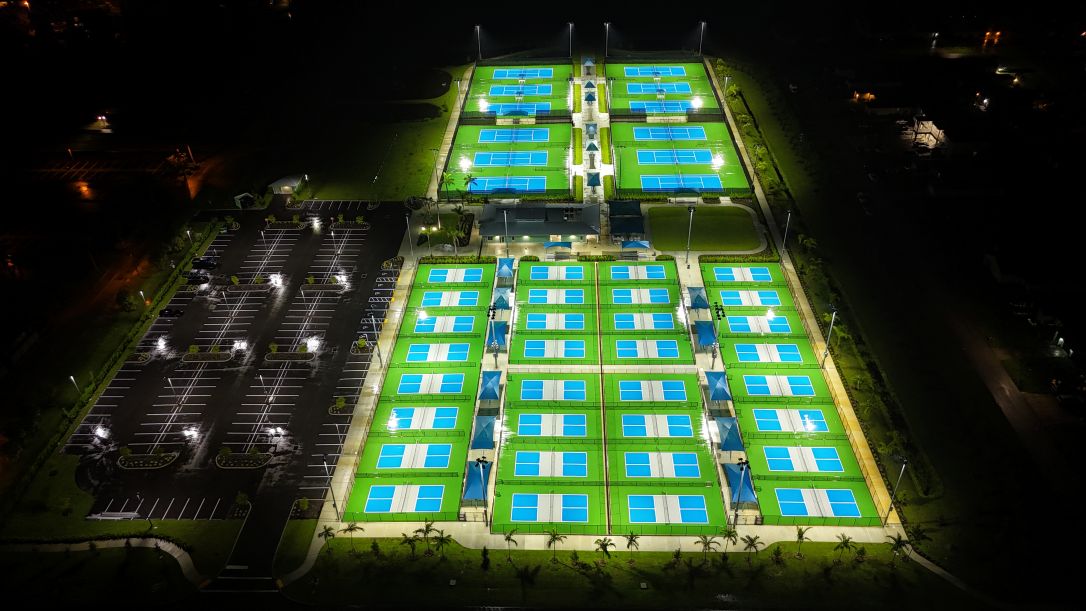
The ideal solution, according to USTA, is the development and/or expansion of sport-specific public sites. (In other words, there should be separate tennis facilities and pickleball facilities.) Facilities can be offered either as one central complex (but with different courts for each sport) or as two separate facilities.
Option 2: Non-traditional spaces
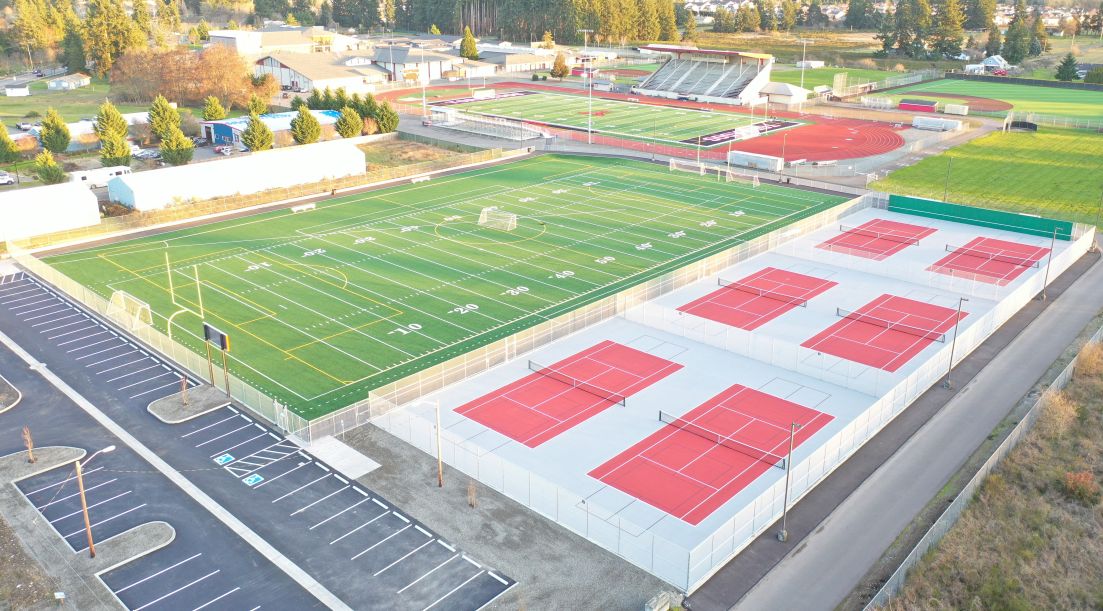
In the event that sport-specific sites are not possible, both tennis and pickleball can be played by creating courts for each in non-traditional spaces. USTA advised looking for hard surface areas that could possibly be converted, such as a concrete slab, multi-sport court sites and/or vacant parking lot locations.
A court contractor can be brought in to measure the space, and to mark it with lines, as well as, if possible, color-coat it for sports use. Pop-up nets for tennis, as well as pop-up nets for pickleball, can be obtained affordably online or from brick-and-mortar stores; a search will yield multiple possibilities.
[Note: When contemplating any type of sports facility conversion, safety must be at the forefront of all considerations. Further, local ordinances should be reviewed to ensure that accessing the space for play is allowed.]Option 3: Shared use of courts
In the event that sport-specific sites and non-traditional spaces are not possible – and in the interest of equitable offerings for both tennis and pickleball – destinations can still allow both sports to be played by having blended lines applied. (Blended lines is the USTA’s term for multiple playing lines on any one surface.)
This recommendation is useful for sites with one or two tennis courts. For sites with three or more tennis courts, every effort should be made to utilize Options 1 or 2 because of the sustained growth and increasing public demand for both sports. Diagrams (which can be accessed through USTA’s Tennis Venue Services Department) illustrate how lines can be added to courts to facilitate play.
If considering adding or converting courts or adding any playing lines, use a skilled court contractor. The American Sports Builders Association (ASBA) has a free online directory (www.sportsbuilders.org) that allows visitors to look up industry members by geographic area, specialty or other criteria.
Differing requirements
Even if the player numbers weren’t a problem, the requirements of both sports are different enough that adding pickleball lines to courts does not create a satisfactory playing experience.
Just as with softball and baseball diamonds, tennis and pickleball courts are very different sizes. Additionally, pickleball nets are lower than those for tennis and, unlike a tennis net, the bottom edge of a pickleball net does not touch the court.
Friction between players of the two sports has also been caused by the sound the pickleball paddle makes when it hits the ball; USA Pickleball, the governing body, has been working on the development of a category of products that reduce the sound.
Getting input from user groups
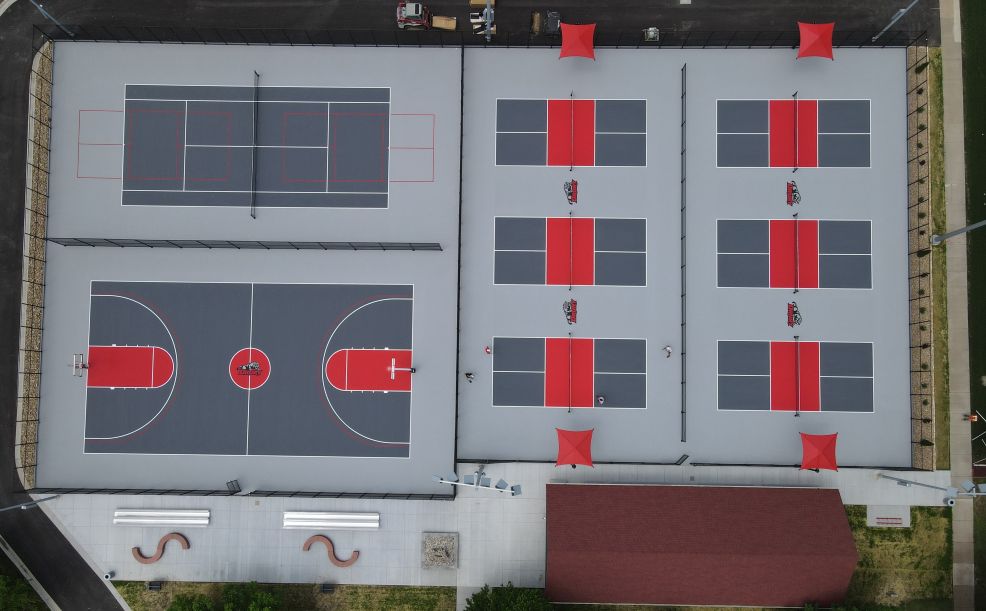
Much pressure is being put on those tasked with management of sports facilities. In many cases, the requests are to add courts for sports like pickleball; while in others, it may be a plea to conserve playing areas for tennis, as well as for other existing sports, such as basketball, or even recreational areas like tot lots and playgrounds.
The bottom line is that if only one group is heard from, it’s easy to discount the needs of the others. For that reason, it is essential to gather input from all user groups prior to embarking on any conversions, construction or other changes.
Tennis and pickleball may not be hugging it out any time soon, but by not rushing to add lines to courts, it is possible to help the two sports exist peacefully.
Mary Helen Sprecher wrote this article on behalf of the American Sports Builders Association (ASBA). For more information, visit www.sportsbuilders.org