
Sponsored content by SOD Production Services
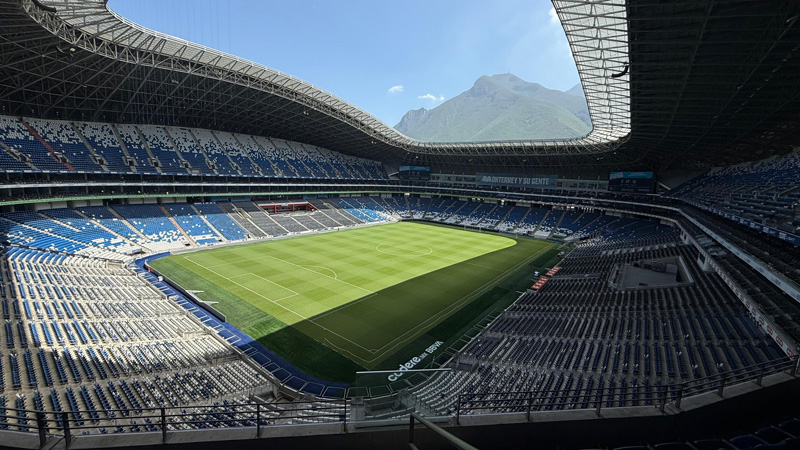
When the 2026 FIFA World Cup begins in June at Stadium Monterrey in Mexico, Carlos Castillo, manager of the pitch and natural areas, said the pitch will be ready for its global debut. For nearly three years, his focus has been to present “the best pitch in the World Cup.” So far, with the feedback he’s received from the FIFA agronomy team, he just might succeed at that goal.
The stadium underwent a substantial renovation, including an all-new pitch with subsurface irrigation, encased by new sand. In July 2025, the pitch was sodded with Tahoma 31 bermudagrass and was played on just two days later.
The selection of the grass itself took countless hours of research. Castillo read through university research, talked to colleagues around the world who managed the grass at their facilities, and consulted with the FIFA agronomy team as often as twice a week. He knew his facility’s unique challenges required a warm-season grass that would stand up to the extreme shade conditions caused by the stadium’s severe overhead wings. He was also concerned with cold tolerance (a leading attribute of Tahoma 31), pitch hardness, and durability.
Weekly reports to the stadium management show progress of the pitch as the World Cup draws near. The Week 47 (mid-November) field assessment showed that the Tahoma 31 hybrid bermudagrass system was performing at elite levels across all agronomic and playability parameters. Turf coverage was at 94% with uniform density, supported by consistent cultural practices including fungicide applications, foliar and granular fertilization, UV lamp treatments, vacuuming, and precision mowing. Performance testing indicated optimal mechanical properties: surface hardness averaged 75 gmax (within the recommended 65–85 range), rotational traction measured 36 N (within FIFA’s 25–50 N standard), and moisture levels at 12%. Ball behavior metrics showed ball bounce at 0.72 m, and ball roll at 8.7 m, confirming a true, fast surface with excellent energy return characteristics. Overall field performance supported both player safety and high-speed professional play.
At a recent visit in November, Castillo noted that the FIFA agronomy team “said that we are the best pitch at the moment of the 16 stadiums of the FIFA World Cup,” Castillo said. Also in November, FIFA President Gianni Infantino confirmed on Instagram that Guadalajara and Monterrey, Mexico, will host the inaugural FIFA World Cup 2026 Play-Off Tournament from March 23-31, 2026. Six national teams will compete for the final two spots in the 48-team FIFA World Cup, with matches taking place at Estadio Guadalajara and Estadio Monterrey.
As of this writing, and in accordance with FIFA’s natural grass regulations that ban artificial turf, it appears that of the 16 stadiums in the 2026 lineup, five will be grassed with warm-season bermudagrass. Of those five, reportedly, three of the stadiums have chosen Tahoma 31 for their pitch surface.
Tahoma 31 is available worldwide through a network of licensed sod producers. Developed by Oklahoma State University, the licensing agent in the United States, South America, and Asia is Sod Production Services. In Europe, the Middle East, and Africa, Semillas Fito is the licensing agent.
Learn more at SFMA booth 737 or visit Tahoma31.com
