
Sponsored content by STEC Equipment
As we approach the wetter, colder seasons, field drainage becomes even more important. Poor drainage can have a huge impact on your field’s health, its playability, and the overall perception of your facilities. No one wants their field and its condition to be the reason that a game, practice, or event is cancelled. That’s why drainage is so important for the life, health, upkeep, and maintenance of your field.
So, how do we achieve effective drainage? And once it’s in place, how do we maintain and improve it?
The easiest way to maximize your drainage and create the best setup is to build a field from scratch with the best subsoils, drainage materials, and design tailored to your area. However, many field managers are tasked with maintaining existing fields. These may be older, improperly graded, constructed with native soils, or lacking subsurface drainage. In these cases, managers must look for strategies to improve drainage without starting over. So what can we do?
Low-Downtime Solutions
For fields that must remain playable with minimal interruptions, options such as aeration, topdressing, and grading are effective first steps. Core aeration is an effective way to remove native soils and amend with sand or profile mix to help change the soil composition that you have, as well as opening your field up and giving the water somewhere to go. A lot of times, drainage issues are a result of the water not being able to penetrate through the surface. This can be from compaction, heavy clay soils, and too much of an organic/thatch layer. Core aeration allows you to remove some of these materials and help with decompaction, giving the water somewhere to flow. The GKB Deep Tine Aerator, for example, is designed to open up heavily compacted fields and create pathways for water movement—making it one of the most effective tools for tackling drainage problems.
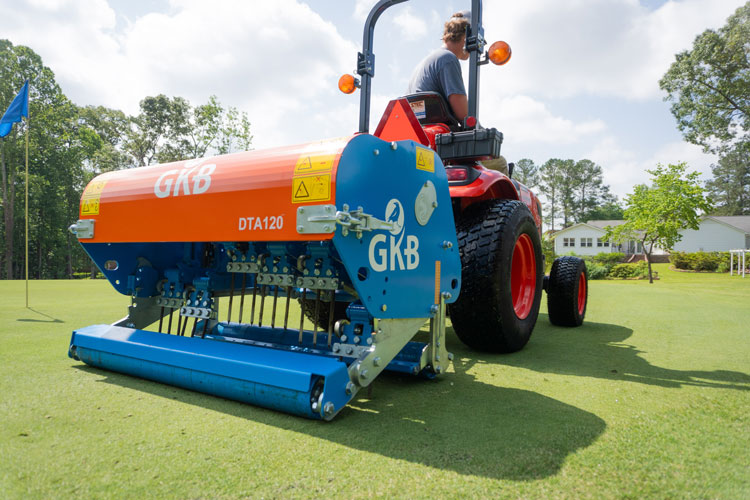
Top dressing, especially after a core aeration, can go a long way toward helping your drainage situation. The sand that fills the aeration holes you made generally drain better than the native soils you are fighting against. Topdressing and grading can help fill in low spots on your fields that hold water and lead to cancellations or delays. You can also use this to help increase the slope or crown of your fields to remove water from the playing surface and towards areas that are not in use by the athletes.
Moderate-Downtime Solutions
Now let’s consider options with a bit more downtime and budget flexibility. Many field managers will use an outside contractor to achieve these results, but it can be done in-house as well with the proper equipment. Fraise mowing is one option to help improve the drainage of your fields. Fraise mowing is removing the top organic buildup layer of your grass (up to 2 inches) while leaving your roots intact. The GKB Combinator is an ideal machine for this kind of renovation, efficiently removing the thatch and organic buildup while preparing the surface for faster recovery. Fraise mowing is helpful if you are working on a field that was built specifically for sports, but is older and has built up a solid layer of organics. The removal of this organic layer can get your field back to those original specs without having to complete a full renovation. It is a budget and schedule-friendly option.
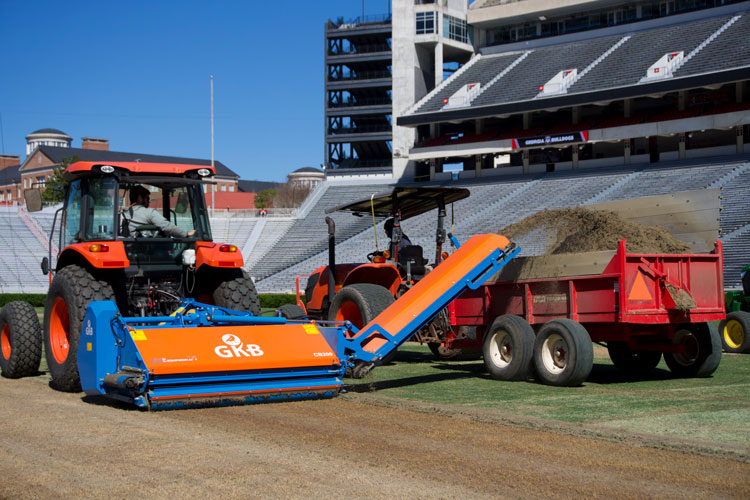
Sand slit drainage is another option for field managers, involving the creation of smaller trenches or slits filled with sand that allow for increased surface drainage. The slits are created by removing soil, and are usually several inches deep and a couple of inches wide. These slits (or trenches) are then filled with sand to allow somewhere for the water to flow through, and can also be used to direct the flow of water away from your playing surface. The downtime on this is quicker than a full fraise mow, as you are not waiting on the entire surface to grow back, only the areas where you created the slits.
High-Downtime, High-Impact Solutions
The most invasive, highest costing, and the option with the most downtime is the addition of subsurface drain tile. This is especially true if you are trying to put this into an existing field that already has irrigation and may have other “infrastructure needs” below the surface, such as other water or utility lines. The subsurface drain tile is installed by digging a trench up to several feet deep, backfilling with rock, laying the drain tile, more rock, and then sand in the top layer to allow the grass to grow back in. While it is the most invasive and probably carries some of the highest costs, it is also the best way. You not only remove the water from the surface and direct it to where you want it to go, but you also achieve somewhere to hold water if it is a larger volume than your infrastructure can handle at the time.
The Bottom Line
Drainage problems can lead to cancellations, lost revenue, turf decline, and frustrated athletes and coaches. These are a few of the ways to improve and maintain your field’s drainage, resulting in healthier turf, reduced downtime, and simpler maintenance in the future.
Let us be a part of your equipment research process. Learn more about STEC Equipment and the high-quality machines and resources we provide turfgrass managers at STEC Equipment.
