
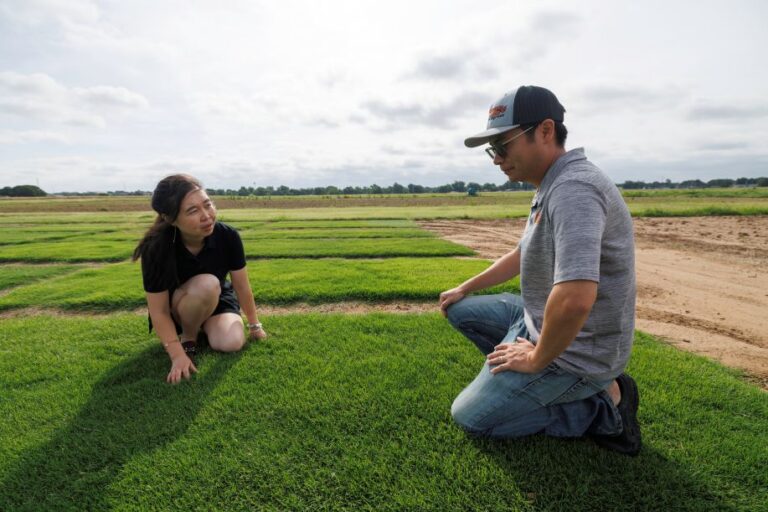
Researchers at Oklahoma State University and Mississippi State University are evaluating bluemuda turfgrass, a system that combines bermudagrass and Kentucky bluegrass to improve year-round turf quality while reducing irrigation needs in transition-zone climates.
Choosing specific types of turfgrass to thrive year-round is a little more straightforward in states like California and Florida, which stay consistently warm, and further north in Minnesota and Iowa, where the weather is consistently cooler. But states in the transition zone, which include Oklahoma, Kansas, Arkansas and Mississippi, experience both extreme summer heat and harsh winter freezes.
“In states like Oklahoma, both warm-season grasses and cool-season grasses have limitations,” said Mingying Xiang, assistant professor in the OSU Department of Horticulture and Landscape Architecture and project leader. “A warm-season grass like bermudagrass goes dormant in the winter, while a cool-season grass like Kentucky bluegrass requires a lot of water in the summertime.”
Bluemuda turfgrass combines warm-season bermudagrass with cool-season Kentucky bluegrass. The multi-state project is evaluating whether the dual system can provide year-round green turf, reduce irrigation needs and lower maintenance costs in transition-zone climates.
“A common practice for maintaining green turf year-round in Oklahoma and surrounding states is to overseed bermudagrass with perennial ryegrass each year,” Xiang said. “For a typical 1.3-acre football field, our estimates indicate that bluemuda turfgrass could reduce initial seed costs up to 45% compared to the traditional system. If the Kentucky bluegrass persists for multiple years, the long-term savings could be even greater.”
In Mississippi, the bluemuda system could provide year-round green turf without the annual expense of overseeding, according to Barry Stewart, an MSU professor in plant and soil sciences.
“We have no doubt that the Kentucky bluegrass will do well in the first fall seeding,” Stewart said. “Identifying a bermudagrass/Kentucky bluegrass combination that provides a sustainable green playing surface will be a boon to Mississippi field managers who manage winter and spring sports like soccer, baseball and softball.”
The project, which started in June, is studying bluemuda turf at two research locations in Oklahoma and one in Mississippi.
“These two grasses grown together will perform differently than bermudagrass and perennial ryegrass do, so we are evaluating six bermudagrasses and 10 Kentucky bluegrasses in 60 different combinations to see which performs best across the three locations,” Xiang said.
The research team is also conducting a survey to ask bluemuda stakeholders and potential users what challenges they face with the dual system and what they would like to see with bluemuda moving into the future. Those interested in participating in the survey can contact Mingying Xiang at my.xiang@okstate.edu.