
By Gerald Henry, Ph.D.; Audrey Young; and Nandita Gaur, Ph.D.
Turfgrass managers apply athletic paints to field surfaces in order to create boundary lines and logos that provide direction and aesthetics for a range of sporting events. Most of these paints are water-based acrylic latex containing a variety of pigments, resins, solvents, and additives, so application is required weekly during field play. Although responsible for different chemical functions, each of these paint constituents has the potential to disrupt turfgrass and soil function.
The accumulation of paint over time has been previously associated with disruption of light in the visible spectrum reaching the leaf surface and, therefore, a decrease in photosynthetic activity of the turfgrass canopy (Reynolds et al. 2012). In fact, Segars and Moss (2014) observed a reduction in photosynthesis when turfgrass foliage was covered in darker paint colors, while canopy temperatures increased in response to the colors black and green. Decreases in photosynthetic activity often translate to reductions in turfgrass quality through canopy thinning. Reductions in leaf carbohydrate content and leaf transpiration in response to paint presence further demonstrate potential long-term impacts on turfgrass health (Reynolds et al. 2016; Segars et al. 2024).
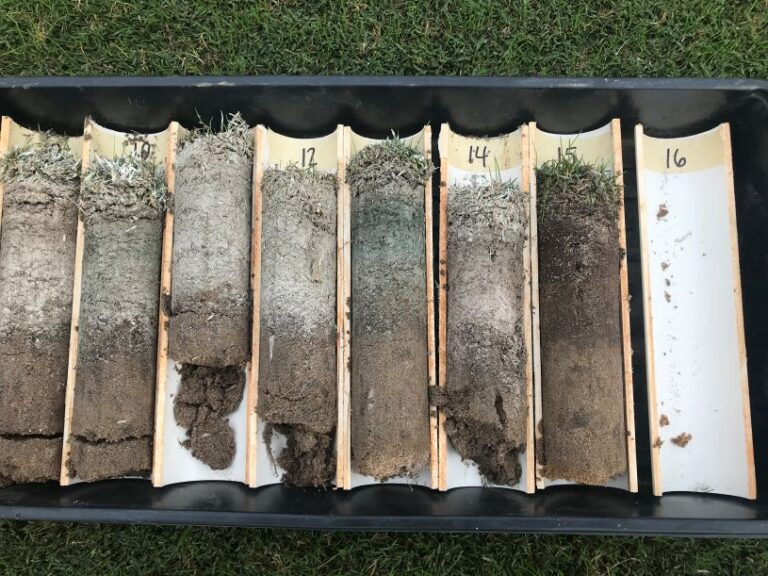
Unfortunately, the influence of paint may extend deeper than the playing surface. Hollow-core aerification practices conducted on sand-based soil profiles often reveal paint migration. This has been confirmed through several social media posts depicting pictures of collegiate fields following aerification or soil samples obtained by university turfgrass managers (See Fig. 1 above).
Monetary costs, labor, and disruption in play often limit the frequency of athletic field renovation; therefore, paint penetration can be exacerbated over time. Athletic field paints often contain clay-based pigments and latex binders. It is well established that increasing clay content generally decreases effective pore diameter by blocking larger pores, thereby increasing soil water retention and field capacity while reducing saturated hydraulic conductivity (Awedat et al. 2021). Similarly, latex and acrylic binders can alter soil physical properties by coating soil particles, bridging aggregates, and modifying pore-size distribution (Park et al. 2021), which in turn affects hydraulic conductivity, infiltration, aggregate stability, and water retention behavior (Andry et al. 2009). In engineered sand rootzones, polymer amendments have also been shown to increase moisture retention by altering pore connectivity and capillary flow pathways (Alvarez et al. 2016). Thus, it is theorized that athletic field paint can modify soil physical properties of sports fields and consequently impact functionality.
Soil characteristics such as bulk density, field capacity, saturated hydraulic conductivity, and wilting point are key physical parameters for the quantification of soil functionality within a turfgrass system. Field capacity, defined as the amount of water held by soil following the stoppage of downward water movement, helps determine effective plant available water (Veihmeyer and Hendrickson 1949). Decreases in field capacity could initiate acute drought stress, reduce nutrient uptake, and limit root proliferation (Fang et al. 2017). Saturated hydraulic conductivity (Ksat) is a measure of how readily water can pass through saturated soil and can be used to determine athletic field drainage (Usowicz and Liplec 2021). Decreases in saturated hydraulic conductivity might result in oxygen deficiency, reduced nutrient availability, and root inhibition (Dexter et al. 2004).
Application variability of painting practices in combination with potential changes to soil physical properties and function may further complicate turfgrass management and athletic field performance. The identification of specific soil characteristics affected by the presence of athletic field paint could modify current management practices to account for within-field variability. Therefore, the objective of our research was to determine whether the presence of athletic field paint within the soil profile impacts soil physical properties and functionality.
UGA field paint research
Research was conducted in the summer of 2024 at four natural grass sports fields located throughout the metro Atlanta area in Georgia (Pace Academy in Mableton, Georgia; The Westminster Schools in Atlanta; Holy Innocents’ Episcopal School in Atlanta; and Wesleyan School in Peachtree Corners, Georgia). Each field was constructed to United States Golf Association (USGA) specifications and were primarily used for varsity level sports including American football, soccer, and lacrosse. No renovation was conducted within the past five years, and all fields were surfaced with hybrid bermudagrass.
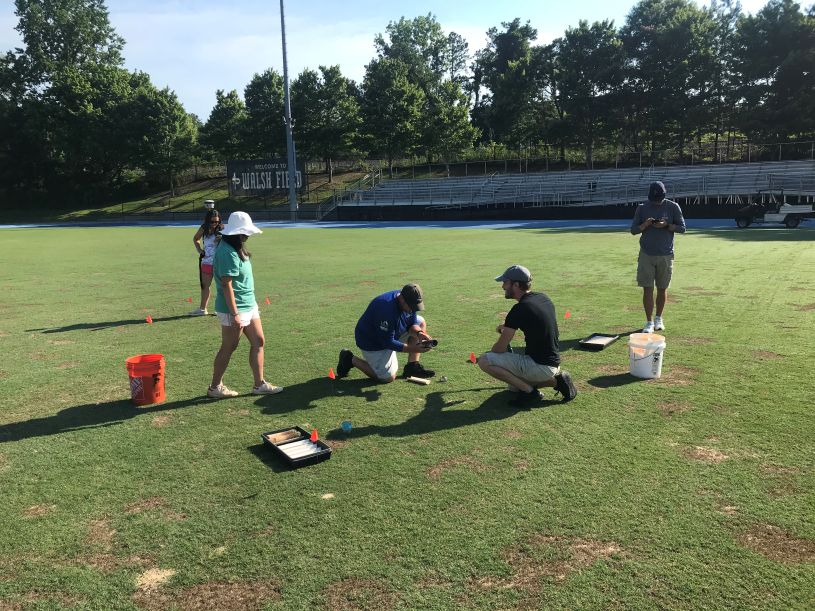
Volumetric water content (%VWC) maps were created to guide sampling areas within each field in order to account for any underlying conditions related to soil moisture. Eight non-painted and eight painted samples were collected from each athletic field with sampling rings hammered into the ground until the top of the ring was flush with the soil surface (Fig. 2).
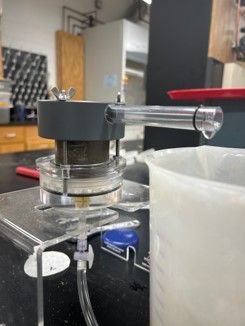
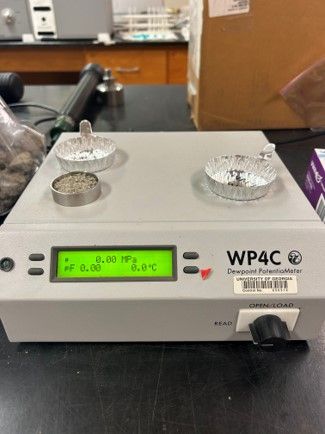
Rings were dug out of the ground and analyzed in the UGA Soil Physics Laboratory in Athens, Georgia. Bulk density, field capacity, saturated hydraulic conductivity, and wilting point were all calculated using a variety of state-of-the-art laboratory equipment (Fig. 3).
Results and discussion
No definitive trends were observed between painted and non-painted samples with respect to saturated hydraulic conductivity or wilting point.
Bulk density
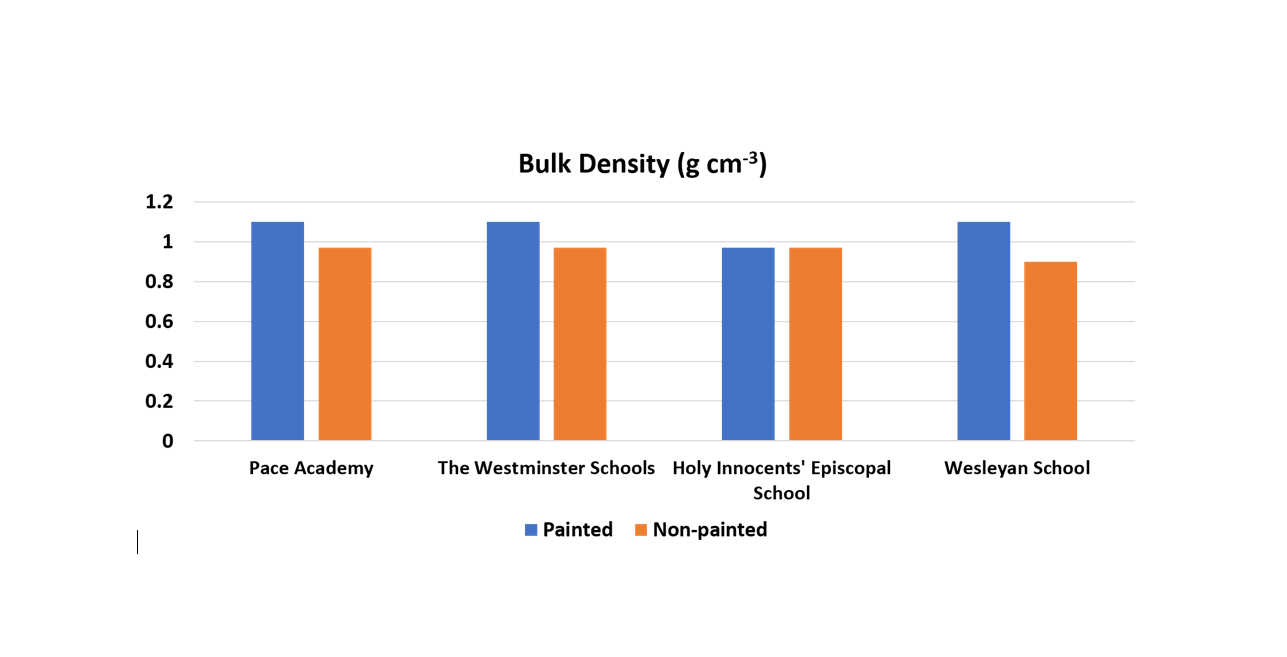
The bulk density of painted samples was higher than non-painted samples for all fields except Holy Innocents’ Episcopal School (Fig. 4). This aligns with our theorized understanding that acrylic-latex-based paints introduce synthetic polymers and heavy pigments, which may decrease soil porosity by displacing gas-filled pores with denser solid materials. One explanation for the lack of differences in bulk density at Holy Innocents’ Episcopal School may be attributed to organic matter content. Holy Innocents’ Episcopal School had the highest organic matter content (3.62%) followed by The Westminster Schools (2.58%) and Pace Academy (2.26%), with Wesleyan School registering the lowest (0.56%). Since organic matter is much lighter and more porous than sand particles, a greater accumulation of organic matter would increase soil volume more than it would increase mass.
Field capacity
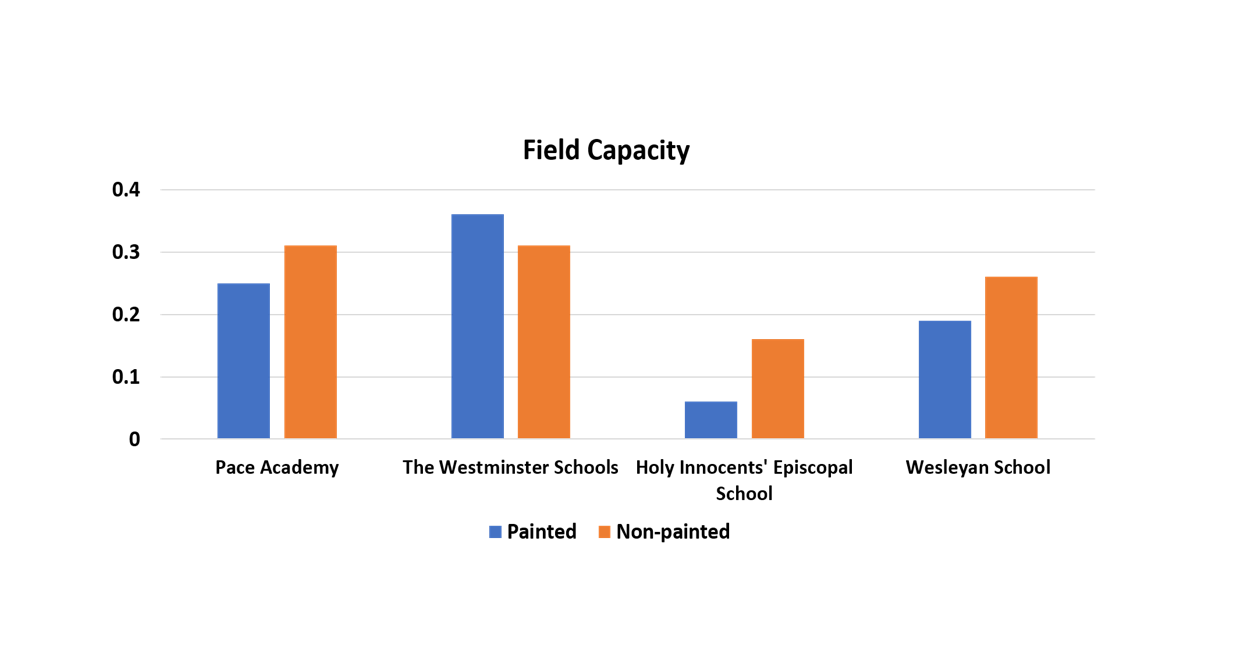
Field capacity in sandy systems increases with clay and organic matter content. Consequently, in line with expectations, field capacity values for non-painted samples at Pace Academy (0.31 m-3 m-3) and The Westminster Schools (0.31 m-3 m-3) were higher than Wesleyan School (0.26 m-3 m-3) (Fig. 5). Featuring the highest organic matter and clay content, Holy Innocents’ Episcopal School (0.16 m-3 m-3) again deviated from traditional expectations, even among non-painted samples.
Since paints also add clay and latex binders to the soil system, we theorized that pore size distribution would become further constricted, resulting in an increase in field capacity for soils receiving paint applications. However, this was only observed for The Westminster Schools, while a general decrease in field capacity was observed with the addition of paint for the other three fields that were sampled. We hypothesize that this contradictory impact may result from the chemical nature of paint binders (resins and polymers). While they may adhere to sand particles, subsequently reducing interconnected voids within the soil profile, they also increase hydrophobicity via paint additives like alkyl amines (Kim et al. 2023), thus not allowing the pores to effectively retain water.
Conclusions
Although several studies have evaluated the impact of athletic field paint on plant physiology, few have investigated the influence of acrylic-latex-based paint presence on soil physical properties. Paint application to athletic fields may cause an increase in soil bulk density over time. Since paint is not applied uniformly across fields, this may increase surface hardness and soil compaction variability, further complicating field playability and athlete safety. Straw et al. (2018) reported a potential relationship between ground-derived athlete injuries and surface hardness variability, with most injuries occurring in areas of transition between non-significant and significantly low and high surface hardness values. Routine aerification applications have been shown to decrease bulk density; therefore, soil cultivation practices may be required more frequently in order to reduce negative impacts of paint presence within the soil profile. Targeted or site-specific aerification may be employed on more intensively painted field locations including school logos, numbers, and endzones. Wetting agents can be used to alleviate poor water retention as a result of increased bulk density by breaking down the surface tension of water. This may be appropriate when invasive cultivation strategies cannot be employed; however, this is not a solution for soil compaction and sequential applications may be necessary.
Gerald Henry, Ph.D., is the Athletic Association endowed professor of Environmental Turfgrass Science at the University of Georgia.
Audrey Young is a former MS graduate student at the University of Georgia. She is currently employed as the outreach and education specialist for the Georgia Cotton Commission.
Nandita Guar, Ph.D. is an associate professor of Soil Physics at the University of Georgia
REFERENCES
- Alvarez, G, Sevostianova, E, Serena, M, Sallenave, R, Leinauer, B. 2016, Surfactant and polymer-coated sand effects on deficit irrigated bermudagrass turf. Agron. J. 108:2245-2255.
- Andry, H, Yamamoto, T, Irie, T, Moritani, S, Inoue, M, Fujiyama, H. 2009. Water retention and hydraulic conductivity of hydrophilic polymers in sandy soils. J. Hydrol. 373:177-183.
- Awedat, AM, Zhu, Y, Bennett, JM, Raine, SR. 2021. The impact of clay dispersion and migration on soil hydraulic conductivity and pore networks. Geoderma 404:115297.
- Dexter, AR, Czyż, EA, Gaţe, OP. 2004. Soil structure and the saturated hydraulic conductivity of subsoils. Soil Till. Res. 79(2):185-189.
- Fang, Y, Du, Y, Wang, J, Wu, A, Qiao, S, Xu, B, Zhang, S, Siddique, K, Chen, Y. 2017. Moderate drought stress affected root growth and grain yield in old, modern and newly released cultivars of winter wheat. Front. Plant Sci. 8:672.
- Kim, SW, Song, WY, Waldman, WR, Rillig, MC, Kim, TY. 2023. Toxicity of aged paint particles to soil ecosystems: insights from Caenorhabditis elegans. Environ. Sci. Technol. 58(1):231-241.
- Park, SS, Lee, JY, Kim, YS, Kim, CW. 2021. Application of an acrylic polymer and epoxy emulsion to red clay and sand mixtures. Polymers 13(19):3410.
- Reynolds, WC, Miller, GL, Livingston, DP, Rufty, TW. 2016. Athletic field paint color impacts transpiration and canopy temperature in bermudagrass. Crop Sci. 56(4):2016-2025.
- Reynolds, WC, Miller, GL, Rufty, TW. 2012. Athletic field paint impacts light spectral quality and turfgrass photosynthesis. Crop Sci. 52(5):2375-2384.
- Segars, CA, Moss, JQ. 2014. The effects of athletic-field color on net photosynthesis and canopy temperature of overseeded perennial ryegrass. Appl. Turfgrass Sci. 11(1):1-3.
- Segars, CA, Moss, JQ, Martin, DL, Wu, Y, Maness, NO. 2024. Athletic field paint reduces carbohydrate content in bermudagrass. Int. Turfgrass Soc. Res. J. 15:1-6.
- Straw, CM, Samson, CO, Henry, GM, Brown, CN. 2018. Does variability within natural turfgrass sports fields influence ground-derived injuries? Eur. J. Sport Sci. 18(6):893-902.
- Usowicz, B, Lipiec, J. 2021. Spatial variability of saturated hydraulic conductivity and its links with other soil properties at the regional scale. Sci. Rep. 11(1):8293.
- Veihmeyer, FJ, Hendrickson, AH. 1949. Methods of measuring field capacity and permanent wilting percentage of soils. Soil Sci. 68(1):75-94.